
The Greenhouse Effect
There is a body of opinion that the "greenhouse effect"
(the trapping of heat by a "greenhouse layer" of various gases, mainly
carbon dioxide) is increasing as a result of man's activities.
It is difficult to avoid, in the press, constant reference to 'combatting
climate change' by reducing carbon emissions (this means carbon dioxide).
There are very good reasons why we should ration energy supplies, and limit our use of
fossil fuels, but they have nothing to do with carbon dioxide.
The earth's resources belong to our descendants (including those not yet born) as much as they belong to us. We should
not waste fuel or anything else. But 'limiting carbon emissions' is likely to have no effect whatever on the temperature of our planet.
There is no evidence of a link.
OBSERVATIONS
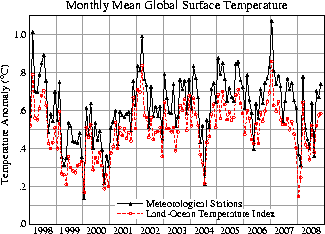
Global temperature fell from 1940 to 1970, rose to 1998, and has fallen since.
It is now at a similar level to 1990. There has been no significant warming since 1995.
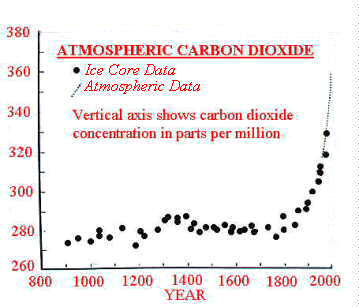
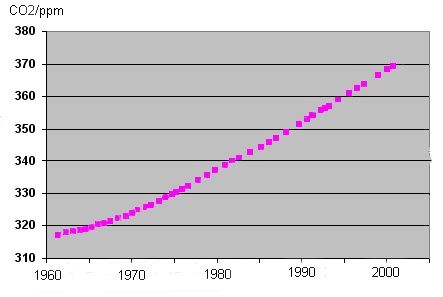
Atmospheric carbon dioxide concentration, on the other hand, has increased at a near constant rate:
by more than 30% since 1940 and by 8% since 1990.
The carbon dioxide levels in the atmosphere and the measured temperatures do
not correlate.
Look at the graphs:
Carbon dioxide concentration, historical
Carbon dioxide concentration, ppm, recent
Average monthly temperatures, global, from NASA website, 1998-2008
...
The media tell us there is a link, and that we must do whatever is necessary (regardless of expense?) in
reducing carbon dioxide.
I cannot understand this. Surely we should be using our money wisely - designing new energy
technologies, preparing for possible changes in climate and sea level (which are likely to occur eventually anyway),
updating sea defences, ensuring security of
our energy supply, and so on, so that if the unthinkable happens, we
are equipped to cope?
Now - let's take a look at some 'greenhouse gases'.
The ones below are known to trap heat effectively. Their contributions
to the greenhouse effect are shown, based on their concentrations (parts per billion) and adjusted
for their heat retention characteristics. (calc. done by Fred Singer, atmospheric physicist)
95.000% water vapour
3.618% carbon dioxide
0.360% methane
0.950% nitrous oxide
0.072% CFCs and other gases
The calculations have been done many times, and there is reasonable agreement between different authorities. It is not disputed that the main greenhouse gas, by a long way, is water vapour. Everything else is tiny in comparison.
If carbon dioxide is responsible for such a small fraction of the greenhouse effect, one wonders why
so much time, effort and money are being used in reducing carbon dioxide emissions.
The reasons cannot be scientific.
The tiny contribution of carbon dioxide to global warming makes a nonsense of any attempt to 'combat climate change' by altering its concentration.
One is reminded of King Canute demonstrating that no man can stop the tide.
And yet we are told that there is a global consensus of 1600 scientists who believe that man-made global warming threatens our future.
What is going on?
ND comment:
Someone asked me a question recently about the "consensus" mentioned above. Regarding
scientists working in the public sector, he said
"how free are they to express views which may be against current government thinking?"
Regarding global warming, I told him it's not surprising that so many are sceptical.
A few days ago the weather forecasters said that the UK was due for
six inches of snow and days of traffic chaos. We got an inch, and it was gone within 48 hours.
If we can't forecast
the weather two days hence, what chance do we have with predictions about global warming?
FOOTNOTE
Curiously, the day this article was completed, I found that the Australian academic Jon Ray had
made some comments about scientists working in the public sector:
.........how seriously can you take the scientific consensus when there's a debate about whether to use
90% or 99% as the likelihood that we're changing the earth's climate? That's not science. That's politics.
How seriously can you take the scientific consensus when there are serious scientists
suggesting the whole thing is a hoax? These folks aren't saying the estimates are off by 10%.
They're saying the whole thing is a hoax.
How seriously can you take the scientific consensus when you
know that a lot of the experts are on the government and foundation funding gravy train and their
livelihood depends on remaining on the right side?
For the full article, see Jon's blog, 11 Feb 07.
